



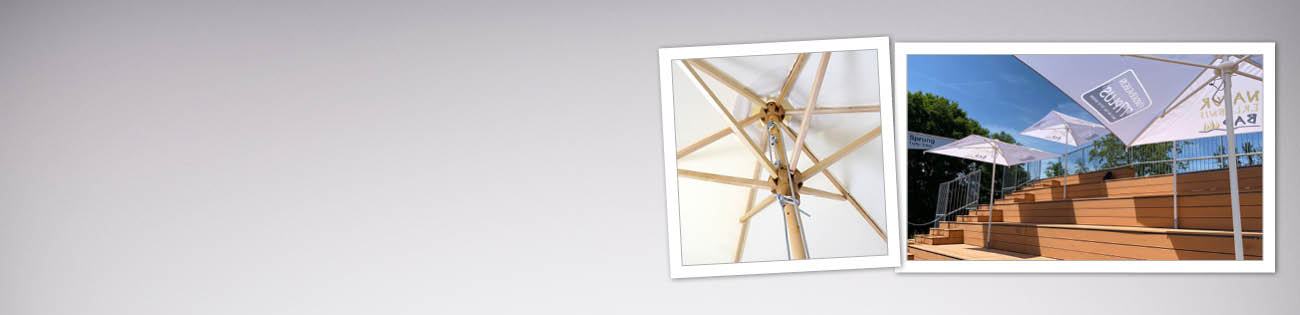
10 tips for purchasing branded parasols
Find the perfect commercial parasol
Whether for use in restaurants, as a shade provider in your own garden, or as a small sunshade on the beach: the applications of parasols are diverse. We explain, which features you should pay attention to, in order to find the parasol-model perfectly suited to your needs!
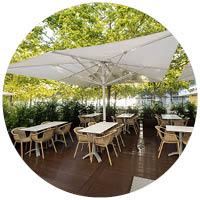
Disadvantage: heavier and less mobile than small parasols
- Examples of use: restaurant gardens
- Öffnungssysteme: meistens mit Handöffnung
- Mobile large parasol
- Diameter: up to 4 metres
- Opening system: wire rope hoist or slider
- Frame: Aluminium
Advantage: more flexible and mobile than large parasols due to two-part aluminium frame
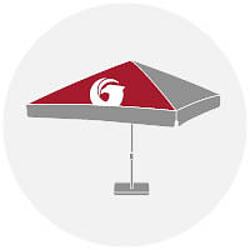
Disadvantage: takes longer to put up and take down
- Examples of use: events and functions
- Öffnungssysteme: meistens mit Kurbelöffnung
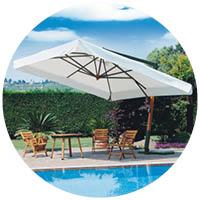
- Cantilever parasol
- Diameter: up to 4 metres
- Opening system: crank opening system
- Advantage: large parasols with a mast at the edge for more space under the canopy and easy use.
Disadvantage: due to the design and opening system, it is less mobile, heavier and more expensive than regular large parasols.
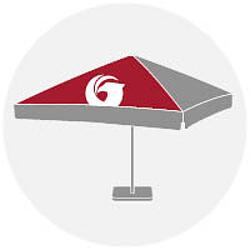
Examples of use: restaurants and cafés on busy promenades
- Go to cantilever parasols
- 2. The optimal opening system
- When deciding on an opening system, it depends on what the parasol will be used for and how often. Depending on the opening system, the required effort, comfort and respective table clearance are different. There are basically four different systems:
- Hand
- Wire rope hoist
- Push-up (with telescopic function)
Crank opening (with telescopic function)
3. Parasol shape
3. The right shape and size
Small parasols are mainly available in a round shape, while large parasols are both round and square. In the case of large parasols, taste is the main deciding factor when choosing the shape of the parasol. However, two details should be taken into account when making your decision:
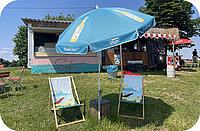
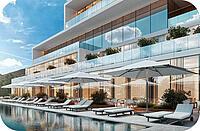
Square parasols have an advantage over round parasols. If you set up several square parasols next to each other, you will create a shaded area with almost no gaps.
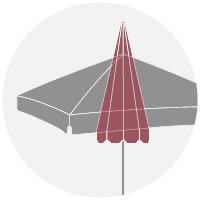
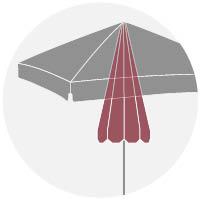
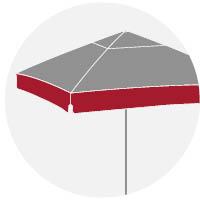
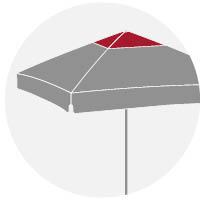
Every parasol is also available with an optional valance. Some parasols also have a wind hood on the canopy.
Valance: A valance offers the possibility of additional advertising on promotional parasols. This is particularly advantageous for large parasols because they are rarely visible from above when unfolded. Furthermore, a valance offers additional protection from the sun and somewhat conceals the metal frame. For fashion reasons, however, it is possible to decide against a valance, as parasols without a valance can appear more modern.
- Wind hood: A storm hood provides additional wind stability and is particularly useful for parasols with a diameter of 3 metres or more.
- 5. Table clearance
- If you are planning to use them in combination with tables and other furniture, you should definitely also pay attention to table clearance when buying large parasols.
- What does table clearance mean?
- Table clearance means that a parasol can be opened or closed without having to remove tables or chairs underneath.
- How do you achieve greater table clearance?
- Stabzug (mit Teleskopfunktion)
6. Printing on parasols
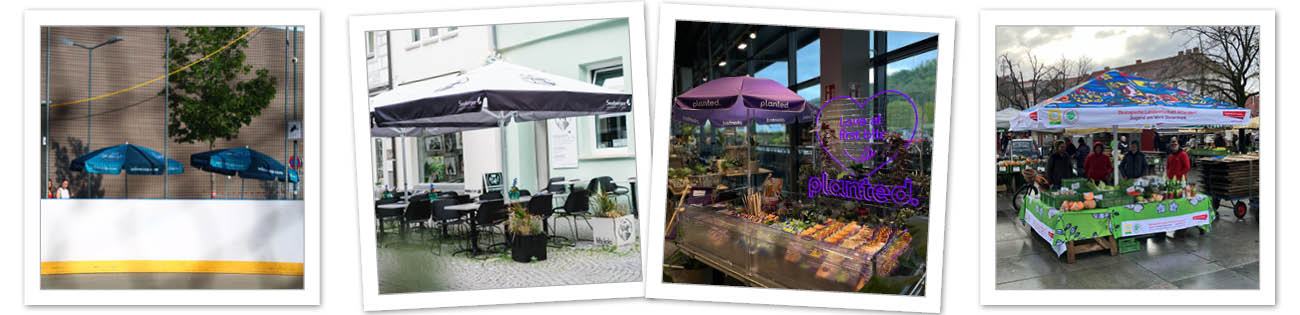
Parasols offer an excellent advertising space. In principle, all parasols can have printing over the entire surface or just in specific areas.
Table clearance means that a parasol can be opened or closed without having to move the tables or chairs standing underneath it.
You achieve maximum table clearance with telescopic parasols. On these models the mast extends accordingly as the parasol is closed and opened.
The fabric of parasols is usually exposed to sunlight for many hours. The demands on the colours in particular are very high. The fabric of parasols can be dyed or printed in different ways. Different colours are used depending on the printing technique, which withstand intensive UV radiation for different lengths of time.
Of course, you should also pick out suitable accessories for your parasols. The most important parasol accessory is the stand. Please note that it must be sufficiently heavy, depending on the size of the parasol. For an easy calculation of the weight, we have created a calculator for parasol stands.
Parasol stand types
Water and sand stands: Filled with water and sand, only suitable for small parasols
Plate stands: Very stable, must be weighted down with stone plates
Concrete or granite stand: Very stable, but massive and heavy
Ground socket: Is permanently sunk into the ground and poured with concrete for maximum stability


Rain gutters (for controlled water drainage when combining square parasols)
Parasols also make an excellent advertising surface. As a rule, every model can be printed over the whole surface or in selected areas.
The route to the perfect promotional parasol is remarkably simple. Just outline your ideas to us and we will gladly produce a first 3D view. If you prefer, you can design your parasol yourself with our exclusive 3D designer – simply open the designer for the product of your choice and get started.
Depending on the motif and where the parasol will be used, different printing techniques come into play. Take a look at our printing technique overview or ask our experts for advice directly.
Wind: Parasols must always be wind-resistant, although there are great differences depending on the design. Therefore, it’s crucial you choose the right model and a suitable parasol stand depending on where you plan to use it. Parasols are generally not designed for use in strong winds.
The right accessories are of course part of any parasol. The most important parasol accessory is the base. Note that the base must be heavy enough for the size of the parasol. To calculate the right weight quickly and easily, feel free to use our weight calculator for parasol bases.
Types of base:
- Fillable bases: filled with water and sand, suitable only for small parasols.
- Plate bases: very stable, must be weighted down with several stone slabs.
- Concrete or granite bases: very stable, but bulky and heavy.
- Ground socket: sunk permanently into the ground and set in concrete for maximum stability.
Further accessories:
- Protective covers (for better protection during storage and transport)
- Lighting (for use at night)
- Patio heaters (for use in cool temperatures)
- Rain gutters (for controlled water run-off when combining several square parasols)
- Parasol walls (for protection from light wind and to combine with patio heaters)